

Absolutely.
Short Review: Thank you Clint Eastwood for giving liberal Hollywood a solid kick in the daddy sacks on your way out the door.
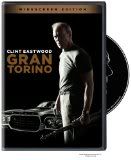

This is a great movie. There are many aspects of the film worth praising but in my mind, I keep coming back to the work of screenwriter Nick Schenk. Schenk has given us a tightly constructed and meaningful script worthy of every screenplay award out there. While it is very possible that a good portion of the lines in the film were improvised, Schenk's storyline and character work are very impressive.
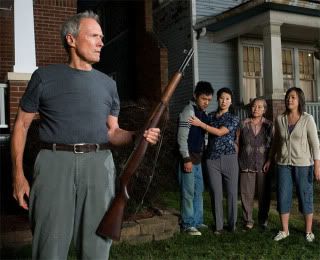
The actual plot is not a marvel. A weathered old Korean War Veteran, who has seen his neighborhood disintegrate into a ghetto, comes to the aid of a Hmong family next door. The veteran, Walt Kowalski (Clint Eastwood), spits racist taunts at the family, but still finds common ground with them once they are confronted by a local Hmong gang. Until the last ten minutes or so, the plotting is pretty conventional stuff. Unpredictability is not one of the film's selling points. Where the film strikes gold is in its characterizations and dialog. Schenk and Eastwood (who directed the film) masterfully deliver what I believe to be the best characters recent memory. Schenk's Kowalski seems custom built for the actor. Eastwood digs into the character and gives one of his best performances (he'll never do better than Unforgiven). Making Kowalski a sympathetic guy is no easy task. He is a bitter, grumbling, racist who doesn't have much time for people. He opens as a stoic, granite-faced curmudgeon. As the film progresses and he finds a relationship with the Hmong family next door he softens and the man inside emerges. All the while he speaks his mind, no matter how vile his thoughts. His frank honestly, regardless of the racist wording he uses, makes him endearing in a strange way.
A word about the racist dialog in the film. If you are sensitive to blatant displays of racism this is not a film for you. Eastwood spouts out racist comments that are shocking in this age of sensitivity and PC. I found the use of racism in the film to be smartly played. At first it is used to establish the disconnect Kowalski has with his neighbors and how much of an alien he has become in his own home. Not only does Kowalski sneer at his Hmong neighbors, they sneer right back asking "why doesn't this American leave?" As Kowalski grows closer to the family he retains his bigoted language. But the tone of it changes. Instead of being hatred it is used to show a strange bit of respect in the same way two friends will viciously mock each other as a sign of friendship. You can say something hurtful to me but it doesn't matter, you still like me and I still like you. There's this difference between us but it is irrelevant. This relationship is buttressed by Kowalski's banter with his Italian barber Martin (wonderfully played by John Carroll Lynch). The two men rip each other mercilessly with of the worst racist language possible. At one point Kowalski brings in a Hmong teen who he has taken under his wing. To teach him how men talk to one another he teaches the teen to assault the barber with bigoted bile. The scene is the film's best. In an age where we pretend even unintended phrasing is somehow akin to being a founding member of the KKK, the display of race based dialog in this film is somewhat refreshing to hear. This is not because I'm harboring some sick need for racist talk but because I love honesty. Who wouldn't rather have people talk frankly about what they're thinking than all of this East Coast liberal double-talk sensitivity we live with today?
The film also does a fantastic job of showing America as it stands today. The "American Century" is over and Kowalski perfectly represents that bygone era. American industry is dead or dying (Kowalski worked at a Ford plant his whole life) and the country's demographics are quickly changing. The promises of the past have not paid the dividends as expected. What it has left is a generation of spoiled, self-absorbed monsters who have no sense of history or decorum. Kowalski's grumbling in the first act speaks for anyone concerned for the country. We are headed somewhere and not many people think its someplace nice. What shows promise is that in the opening scene, at Kowalski's wife's funeral the grandchildren arrive wearing sport jerseys and tank tops. While my generation has raised what appears to be the worst generation ever, populated with people who would wear flip-flops to a funeral, I found it comforting that its still possible to show this behavior as bad form. The concept of respect is still there someplace in our society. Over and over while I watched the film I kept thinking about how disappointing it must be to be elderly today. You've sacrificed your whole life, you've gone to war you've worked and saved and you look and see a country filled with dome-drink sipping, ipod zombies who don't even remember the name of the war you fought in.
This is a great film. I recommend it fully.
Related Reviews:
Clint Eastwood movies
Letters from Iwo Jima (2006)
Dirty Harry (1971)
Other Critic's Reviews:
Christianity Today
The Independent Critic

Labels: Clint Eastwood, film, movie review, racism
posted by Michelle Obama's Left Nut at 11:04 AM
2 comment(s)


Share
No.
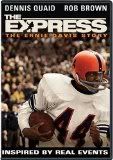

The “first black to do x” template (in particular in relation to sports movies) is tedious and it has to go. The Civil Rights struggle was a struggle, point taken. Does this mean we have to work over the issue the same exact way a hundred times?
It is saying something that Hollywood has to continue to dip back forty plus years to find instances of notable racism in American society. Today are there still divides? Sure, there always will be and those divides go both ways. The fact is the Civil Rights Era has brought fruit and this continual mulling over the past is unhealthy, not because it’s wrong to investigate our collective pasts but because it way its presented and how it shades our lives today. The point of these films (Men of Honor, Glory Road, Pride, and on and on) is not to show how far we’ve come, but to chain today to past sins. These sins committed by people most of never knew, or are even related to. Blacks are reminded that they were second class citizens, and white are reminded that they’re all budding racists who should be filled with shame. In these films some pragmatic white, who will benefit directly from the inclusion of blacks, crosses the divide. He’s still spoiled by racism but he can ignore his impulses long enough to get what he wants. In non-sports related Civil Rights Era movies (Mississippi Burning, Ghosts of Mississippi, even Hairspray) the minorities are spared by strong-willed white liberals (almost all East Coast lawyers (Hairspray being an obvious exception) who battle the seething crackers.
This particular production is frustrating because Ernie Davis is a legitimate subject for a film. The problem is that this film never rises above the conventions of the underdog/Civil Rights sports movie. The template is simple: the blacks are brought in and the whites get nervous. The blacks are all helpful, somewhat meek, and hold mild racist views of their own. It is the whites who are burdened by the curse of racism. There is the obligatory scene where the racism of society acts as a wedge in a conversation or social situation. This is often done around a meal where the pragmatic white is cornered by a question or statement which has the subtext of “the world sure is racist!” The pragmatic white has his uncomfortable moment and is forced to slowly chew his food while he fumbles for something to say. Then there are the unprompted threats from white teens. These are usually met by the proud, dominate black teen who stands up to them at which point the white devils melt in fear. So on and so forth. Again, it isn’t that the issue of racism is raised, it should be discussed. The trouble is that the topic of racism is handled in such an obvious and pedestrian fashion. All of this leads to the final half where the blacks integrate and tensions rise until whites learn that blacks can be useful (meaning they can score points in games and win championships) and then everyone gets along. The black players get respect, not because they’re men worthy of dignity and respect, but because they’re useful in a particular social activity. The structure should be offensive to a certain degree since it assumes white racism and casts blacks as being defined by the approval of whites.
It is possible people look at these race-based sports films as being great underdog stories. The underdog aspect of the narratives is there and there are some interesting stories to be mined. I’m left wondering however, if these films are more than blatant social engineering pieces and actually about showing an underdog story then why aren’t there similar movies about Asians, Hispanics or other minorities? Were their struggles for equality missing teachable moments? Where is the story of the first Asian NBA player Wataru Misaka or others? Other minorities are not covered in this fashion because it doesn’t fit the accepted narrative of the country where racism has a hierarchy of pain and embarrassment. According to Hollywood Asians had nothing to do with the history of America until Japanese Americas popped up in 1940 to be rounded-up by the Democratic Administration. Mexicans had little to do with the development of the country other than rushing the Alamo. This is also why we don’t see many positive films about African Americans coming out of Hollywood. It doesn’t fit the template. Other than Tyler Perry where are the uplifting stories focusing on African Americans that show them in a framework outside of being held down by whites? The Civil Rights Era was half a century ago, have we really made so little progress? Will Smith’s Pursuit of Happyness comes to mind but even that had its race/class moments. Why can't Hollywood conceive of showing African Amercians excelling in areas of real importance? Why is it always something ultimately as useless as sports? No, don't bother with Thurgood Marshall, Ralph J. Bunche, Hiram Revels, or Congressional Medal of Honor winner William H. Carney, we're going to stick with football.
I call for a twenty year moratorium on Civil Right Era films, in particular the sports-based ones. Film makers should be forced to show African Americans as they are today, in today’s world not in some navel gazing look at what our grandparent’s or great grandparent’s generations were doing. This will provide us with stories about a nearly untouched aspect of American society (actual positive looks at black America) and will work to undo the destructive stereotypes and canards propagated by our media (against both whites and blacks.)
Giving a final look at this movie, as mentioned above, it is a shame this doesn't work since Davis’ story is an interesting one. As a sports film it doesn’t make the grade because it doesn’t dredge up enough tension. The scenes aren't horrible but they're lacking any drive, any life. In addition, visually this is a very conservative film and there is no innovative moves to make the football sequences stick in the memory. As with the rest of the film, the games pass in and out without much impact. There are better sports films. There are better Civil Rights films. Since that's the case there is no reason to see this one.
Related Reviews:
Sports movies
We Are Marshall (2006)
The Rookie (2002)
Other Critic's Reviews:
eFilmCritic
Spirituality and Practice
Labels: Charles Dutton, Dennis Quaid, racism, sports movie
posted by Michelle Obama's Left Nut at 9:00 AM
0 comment(s)
Share
Looking beyond the obligatory kick in the clackers of the political right and the obtuse display of American flags (and thus making them a symbol of white racism), this movie has plenty going for it. The story of a neo-Nazi who reforms in prison and is then released to find his beloved younger brother heading down the same path is a riveting conflict to watch unfold. At the center of the production, Edward Norton gives one of the better performances of his career. If you can ignore the clumsy attachments director Tony Kaye makes between Nazism and pro-American conservative thought (not an easy concession to make in the final moments of the film) then you will find a interesting drama.
Director: Tony Kane (Snow Blind)
Actors: Edward Norton (The Illusionist), Edward Furlong (The Visitation), Beverly D'Angelo (National Lampoon's Vacation), Avery Brooks, Elliott Gould (M*A*S*H) and Stacy Keach (Mercy Streets)
Labels: Edward Furlong, Edward Norton, film, movie trailer, racism
posted by Michelle Obama's Left Nut at 10:00 AM
0 comment(s)
Share
Absolutely.

Related Reviews:
Movies about race relations
Crash (2005)
Guess Who (2005)
Other Critic's Reviews:
eFilmCritic.com
Greatest Films
Labels: film, movie review, Norman Jewison, racism, Rod Steiger, Sidney Poitier
posted by Michelle Obama's Left Nut at 9:00 AM
0 comment(s)
Share





















Good News Film Reviews LLC 2004-2010 - used with permission
Images, video and titles are the property of their respective copyright holders. Good News Film Reviews LLC claims no ownership or connection to them.
The views expressed on this site are not the opinion of any advertiser or external entity.
While we take care to only link to responsible entities, Good News Film Reviews LLC takes no responsibility for the content linked from this site. There are sharks in the waters. Surf at your own risk.
The Template is generated via PsycHo and is Licensed.