

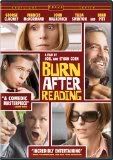

The Coen Brothers have always had seriously problems resolving their stories. The more frivolous their movie, the worse this flaw in exposed. If you watch their works you will find brilliant characterizations in the first half of the film. You will be introduced to fascinating, quirky characters who dazzle with clever dialog. The issue comes when the mechanics of the central conflict are put to work. The Coens always fumble in this regard and this leads their well crafted characters to have nothing to do in the final half of the stories. Like we have seen in The Hudsucker Proxy, The Ladykillers, The Big Lebowski and Intolerable Cruelty, the last forth of this film is patched together in a flurry of plot contraptions in order to brings things to a messy close. This lack of follow through makes for a very disappointing experience. The Coen's set a nice table but their meal is wanting.
The film centers around a collection of misfits from various walks of life. Osborne Cox (John Malkovich,) a surly CIA analyst with a drinking problem, decides to write his memoirs following a demotion at the agency. His bitter wife Katie (Tilda Swinton) is sleeping with Treasury agent Harry Pfarrer (George Clooney). Pfarrer, who is also married, is likewise cheating on his wife and Katie by meeting single women through Internet dating services. This is how he is introduced to Linda Litzke (Frances McDormand) a fitness gym employee. Linda and her co-worker Chad (Brad Pitt) discover Osborne Cox's memoir files on a misplaced CD, left in the gym by Katie's divorce attorney's secretary. The pair decide to blackmail Osborne Cox so Linda can afford to get multiple plastic surgeries so she can be more attractive, which she doesn't have to do since her boss Ted (Richard Jenkins), a former priest, is in love with her.
Phew.
What you may notice is that there is a lot of famous names but not a lot of sense coming out of that previous paragraph. That's what you get with the film. There's plenty of familiar faces but nothing worth remembering. Everyone gives a lively performance (only the Coens pull good performances out of Clooney,) but the convoluted plot mixed with the lack of a compelling conflict results in the film not being worth the effort. You can tell they've hit narrative wall in the second half because the story shifts from clever dialog and upbeat, whimsical plotting to cursing, deviant sexual references and abrupt, hardcore violence. The introduction of low material for no real purpose is always a sign that the writer is struggling to force their way past script issues. Often they are the narrative equivalent to someone shoving something aside an yelling "screw it!" Which, ironically, is what you'll probably say half way through this movie.

Related Reviews:
Other Brad Pitt movies
Meet Joe Black (1996)
Troy (2004)
Other Critic’s Reviews:
Critic After Dark
Roger Ebert
Labels: Brad Pitt, Coen Brothers, film, Frances McDormand, George Clooney, John Malkovich, movie review, Tilda Swinton
posted by Michelle Obama's Left Nut at 9:00 AM
0 comment(s)


Share
No.

Related Reviews:
Coen Brothers movies
O' Brother Where Art Thou? (2000)
No Country for Old Men (2007)
Other Critic's Reviews:
Independent Critics
Almost Fabulous Movie Reviews
Labels: Coen Brothers, film, movie review, Paul Newman, Tim Robbins
posted by Michelle Obama's Left Nut at 11:00 AM
1 comment(s)
Share
Directors: Ethan and Joel Coen (Miller's Crossing)
Screenwriters: Joel and Ethan Coen (The Big Lebowski)
Actors: Brad Pitt (Se7en), George Clooney (Good Night and Good Luck), Tilda Swinton (Orlando), John Malcovich (Dangerous Liasons), Frances McDormand (Fargo), J. K. Simmons (Juno), and Richard Jenkins (Step Brothers)
Labels: Brad Pitt, Coen Brothers, film, George Clooney, J K Simmons, John Malkovich, movie trailer, Tilda Swinton
posted by Michelle Obama's Left Nut at 6:00 PM
1 comment(s)
Share
Should I see it?
Short Review: Great until the final act and then it gets very muddled. It’s like getting great, scenic directions to grandma’s house but once you get there, instead of seeing Grandma’s house, you’re left parked in front of a closed down petting zoo that is being used to hold practices for the local bomb squad. Sure it’s interesting but didn’t someone promise we’re going to grandma’s?
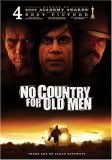

The Coen Brothers' intricate film is beautifully shot, and eloquently written film but it is also marred by their tendency towards self indulgence. They are simply the worst at ending their movies. Their final acts almost always descend into strange musings that are incompatible with the rest of the story. I contend the reason they tend to flounder is because they’re not actually telling stories, they’re describing people. They get so involved in their characters that they forget to propel their narrative into a resolvable direction. In the case of this film, they frankly abandon telling the story and wander off to investigate the ethical issues that curse their characters. It's a little like seeing someone works on a complicated mathematical problem on a chalkboard, only to have them wipe the slate clean before giving you the sum and then begin working on a related problem. If you’re into closure or traditional endings, this film will leave you wanting.
Even with its stuttering resolution, this is a remarkable piece of cinema. It is clearly deserving of all of the awards and praised it has received. Every aspect of the film is masterfully handled and shows a dedication to intricate filmmaking that is a pleasure to witness. The story revolves around three men. Llewelyn Moss (Josh Brolin), a gruff welder, stumbles across the results of a drug deal gone bad in the desert. From this he discovers and keeps a case containing two million dollars. He takes it home to his simple wife Carla (Kelly MacDonald). It isn’t long before the menacing killer Anton Chigurh (Javier Bardem, in an Oscar winning performance) arrives in the area, looking to get the lost loot. Chigurh, with a devil’s smile and a patient, yet frightening, tone tracks down Moss across Texas. He gives the feeling of being supernatural, a symbol more than a man, more on that in a bit. As Chigurh pursues Moss, the killer…well, kills. He leaves a trail of dead hotel clerks, criminals and random people on the road. On this trail, old, crusty sheriff Ed Tom Bell (Tommy Lee Jones) struggles to make sense out of the nonsensical deaths caused by Chigurh’s efforts. This may not seem like a foundation for a great film. In many cases, the story itself is rather pedestrian. Where this movie strikes its cord is in character and in the choices made by the Coens.
This is one of the best character pieces made in recent memory. It is a rare thing to be presented with characters so intensely interesting that there’s a sense of loss when long scenes of dialog end. I wanted to see more about these people, learn more about them. This careful character construction makes the confrontations more tense since the audience is involved on both ends of the fight. When Moss and Chigurh finally meet and fight, I found myself hoping for a draw so the film could continue. I can’t think of the last time this has happened.
This is a fantastic movie that I cannot recommend it highly enough. You have two master filmmakers at the height of their skills working with a cast that meets the high expectations of a brilliant script. What more could you ask for?
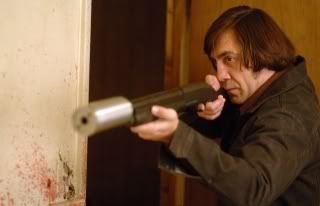
Cautions: This is an incredibly violent movie. It is a study of evil and that evil is expressed in blood. This sanguine film doesn’t push the gore to an unreasonable level and the violence, while quite rough, is handled with respect. It’s not there for the sake of showing something exciting; it goes to build the story. In other words, it’s excusable. This said, it is important for those who are sensitive to seeing violent images to be forewarned that this film is loaded with brutal killings.
Worldview: The film is a search for structure (read God) in this seemingly random world. Two of the main characters, Ed Tom Bell and Anton Chigurh struggle with meaning in different ways. Sheriff Ed Tom Bell tries to think his way to an explanation. He sees the results of men’s dark hearts and the disconnected path of violence. Confronted with this, Bell attempts to keep order and attempts to reason. He fails and ultimately gives up the cause by saying “I always figured when I got older, God would sorta come into my life somehow. And he didn't. I don't blame him. If I was him I would have the same opinion of me that he does.”
Anton Chigurh himself is a remorseless killing machine. In a sense he is much like The Terminator since once he begins on a path to kill someone he does not stop until the task is done. At one point however, a fellow killer says of Chigurh when Moss says he will make a deal with the killer “You don't understand. You can't make a deal with him. Even if you gave him the money he'd still kill you. He's a peculiar man. You could even say that he has principles. Principles that transcend money or drugs or anything like that. He's not like you. He's not even like me.” Chicurh, acts as a grim reaper, slowly but surely coming to claim each soul. He is lost, however, in a meaningless world of death. Casually peddles death seems to be a way for him to define certainty in a strange way. In the film’s best scene, Chicurh confronts a dim-eyed shop owner and has the man call a flipped coin. If the man wins, he lives, if he loses, Chigurh will kill him. Chigurh states about the 1958 coin “It's been traveling twenty-two years to get here. And now it's here. And it's either heads or tails. And you have to say. Call it.” The coin, fate (God) decides the outcome to this man’s life, not Chigurh. He never makes the jump that it is his choice whether to kill or not. He doesn’t recognize that it is not fate but rather his choice to flip the coin in the first place which defines him. God may put him in the situation, but his reaction to it is the key. At the end of the film, and if you haven’t seen the film please stop here because I’m going to give away important parts of the plot, Moss’ wife Carla confronts Chigurh face to face. Chigurh, in a moment of mercy, allows her the flip of a coin to decide her fate.
Carla Jean Moss: You don't have to do this.
Anton Chigurh: [smiles] People always say the same thing.
Carla Jean Moss: What do they say?
Anton Chigurh: They say, "You don't have to do this."
Carla Jean Moss: You don't.
Anton Chigurh: Okay.
[Chigurh flips a coin and covers it with his hand]
Anton Chigurh: This is the best I can do. Call it.
Carla Jean Moss: I knowed you was crazy when I saw you sitting there. I knowed exactly what was in store for me.
Anton Chigurh: Call it.
Carla Jean Moss: No. I ain't gonna call it.
Anton Chigurh: Call it.
Carla Jean Moss: The coin don't have no say. It's just you.
Anton Chigurh: Well, I got here the same way the coin did.
Carla demands Chigurh acknowledge his freewill, his culpability in her murder, in all of his murders. He can’t make the leap, if he comes to admit his actions are of his own making, he is then guilty, an active player in this world and not some random device. Earlier in the film he refers to himself as a “perfect tool for the job”, the job being to kill another person. Chigurh finds his heels stuck in the swamp of a completely fate based world. If man is directed completely by fate then he is nothing more than a tool, a mere function. With freewill, choice, man ignites the sometimes terrible consequence of randomness on the world but he can also be judged for the decisions he makes.
Related Reviews:
Coen Brothers movies
Miller's Crossing (1990)
Intolerable Cruelty (2003)
The Ladykillers (2004)
Other Critic's Reviews:
Dear Cinema
Popcorn Junkies
Labels: adaptation, Coen Brothers, hitman, Javier Bardem, Josh Brolin, movie review, Tommy Lee Jones, Woody Harrelson
posted by Michelle Obama's Left Nut at 7:59 AM
0 comment(s)
Share
posted by Michelle Obama's Left Nut at 10:23 PM
1 comment(s)
Share





















Good News Film Reviews LLC 2004-2010 - used with permission
Images, video and titles are the property of their respective copyright holders. Good News Film Reviews LLC claims no ownership or connection to them.
The views expressed on this site are not the opinion of any advertiser or external entity.
While we take care to only link to responsible entities, Good News Film Reviews LLC takes no responsibility for the content linked from this site. There are sharks in the waters. Surf at your own risk.
The Template is generated via PsycHo and is Licensed.