

Should I see it?
Absolutely.
Short Review: It's like The Matrix without all the black leather, pliable physics and all of that "There is no spoon" blathering.
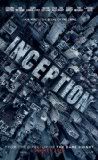

Christopher Nolan (The Prestige, The Dark Knight, Memento) has established himself as the best director of his generation with this film. Then again, his generation includes directors like Brett Ratner, Ben Stiller and Ben Affleck, so he probably shouldn't start gripping his lapels too tightly.
This is a great movie. It is a masterful work. This is one of the most fully realized and complicated movies ever made. When I drag out the word "complicated", I mean Nolan tackles a plot with so many moving, interwoven layers that it is a technical marvel his movie is even comprehensible. The fact that one can walk away from the film with a clear understanding of what happened is worthy of an Oscar at the least.
Leonardo DiCaprio stars as Cobb, a guilt-ridden "extractor". He is a man who has the means, through technology, to enter a person's mind and rob secrets from their subconscious while the subject is in a dream state. Cobb and his partner Arthur (Joseph Gordon-Levitt) are hired by the infinitely wealthy businessman Saito (Ken Watanabe) to reverse their methods. Saito wants the men to not steal a thought from a target, but implant an idea in a man's head. The target? Robert Fischer, Jr. (Cillian Murphy) the troubled heir of a newly dead energy tycoon. The idea? Fischer must have the idea to dismantle his father's massive business empire.
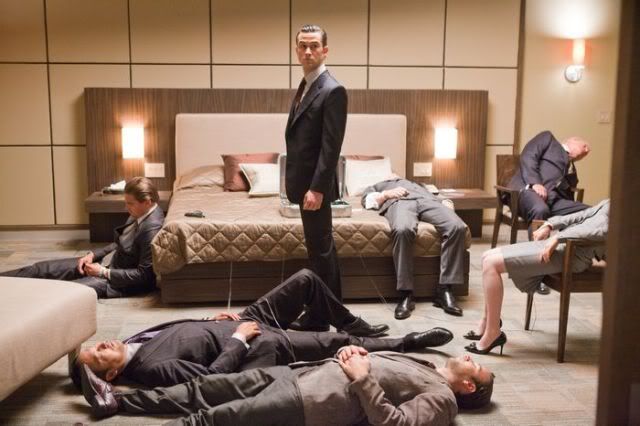 Cobb assembles a crew and gets to work. They knock Fischer out, enter his mind and proceed to drill down into his subconscious. The plot gets complicated when the crew begins to work, not only in Fischer's dreams, but in his dreams inside of his dreams, inside of his dream (and then a little deeper still). You read that correctly.
Nolan has his characters literally working through five different realms of consciousness at the same time and never loses control of his movie. It is logical, visually identifiable and amazingly coherent. This is an amazing feat of storytelling.
If working on all of these levels wasn't a big enough feat, there is the added layer of Cobb's subconscious mind intruding into the the dreams. As with all of Nolan's films, the major element of this story is remorse. Nolan seems obsessed with remorse and guilt. All of his heroes suffer from their pasts, tormented by what they did or did not do. Will Dormer in Insomnia is in anguish over his accidentally shooting his partner, Leonard in Memento is likewise troubled and Bruce Wayne (Batman Begins, The Dark Knight) is defined by his shame. Like these men, Cobb is stunted by the tragic suicide of his wife Mal (Marion Cotillard).
Cobb must overcome his guilt, define it, and ultimately reject it, if he is to move forward in his life. In tandem with Cobb, Fischer must likewise resolve his deeply painful issues with his deceased father. The pair of cathartic character arcs work seamlessly together and are thematically interwoven. Each compliments and enhances the other, bringing about an emotionally satisfying and intellectually fulfilling ending to the film. I've been writing reviews for years and trust me when I say, I don't get to use a sentence like that often.
If there is a downside to the film it is that the movie will be hindered by its connection to The Matrix. While this movie is certainly not a derivative of The Matrix, it will remind many of the sci-fi classic. The characters exist within a dream state. This means much of the movie's universe is pliable and weird things can and do happen. Reality is unsettled and it gets hard to know what is real and what is imaginary.
The Matrix is an important film for many technical and cinematic reasons. I do not mean to reduce its place. The fact is that The Matrix stoops to silly fight sequences, slow motion bullet trickery and is loaded down with meaningless philosophical mumbo jumbo. Inception is clearly the smarter film and avoids these thrill-ride gimmicks.
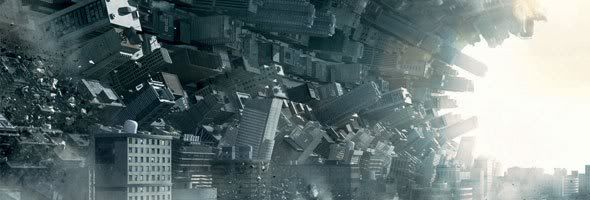
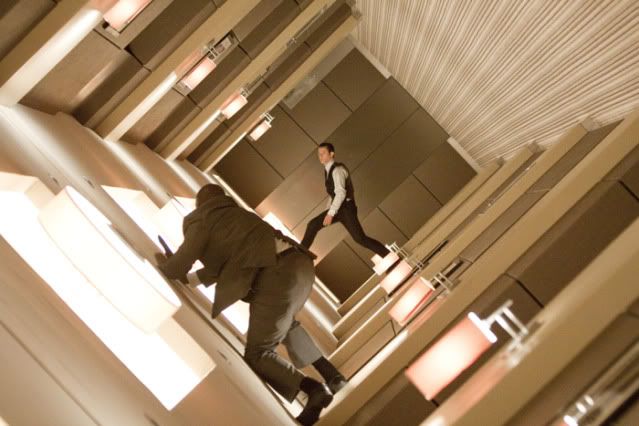
Nolan's film contains some striking special effects, but none of them are out of context nor overdone. He includes the visuals only when it enhances the story. The same goes with his fight sequences. There is a zero-gravity fight at one point. Instead of turning it into a display of "hey, ain't this cool" film making, Nolan has the fight, but keeps his eye on his narrative ball - moving his story forward.
This is a great film. It is as good as you have heard, if not better. It is a complex, moving film and stands as one of the better movies made in the past decade. It is possibly the best film since the turn of the century.*
It is worth seeing on the big screen. It is worth leaving your home, paying too much of your money for a ticket and sitting in a large crowd. That is saying something.
* - It takes more than one viewing to mark something as being the best of anything. Let's see if it holds up over time.
Related Reviews:
Christopher Nolan movies
The Dark Knight (2008)
The Prestige (2006)
Other Critic's Reviews:
Movie Freak
Cinema Blend
Click here to buy your copy of

You Are What You See:
Watching Movies Through a Christian Lens
Labels: Christopher Nolan, Cillian Murphy, Dileep Rao, Ellen Page, film, Joseph Gordon-Levitt, Ken Watanabe, Leonardo DiCaprio, Marion Cotillard, Michael Caine, movie review, Tom Berenger, Tom Hardy
posted by Michelle Obama's Left Nut at 8:00 AM
2 comment(s)


Share
Nope
Short Review: Previous generations got John Wayne, we get a self-hating drunk crying in his beer.
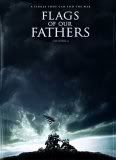

Wake me up if they decide to make a movie about Iwo Jima. This about sums up my experience screening this distracted choppy, dropped ball of a movie.
Clint Eastwood’s film has less to do with the actual battle in the black sands of that remote island and more to do with the marketing campaign back home. The three surviving men, John "Doc" Bradley, Ira Hayes and Rene Gagnon who raised the flag in the famous picture from Iwo Jima are used by the war department as spokesmen for the war bond drive. The film treats this necessity like it was a cynical, terrible assault on human dignity. It probably made the men uncomfortable to be remembered for something as simple as raising a flag, but the goals of the marketing were good. Eastwood plays these segments like the men were being leveraged to sell Coca-Cola.
The bulk of the film shows these men coping with their guilt. Great, Oprah has made a war movie. This is why I loathe this film. People don't read much anymore, and they certainly don’t consume a great deal of history when they do. Films such as this stand as historical monuments. People will know what they know about Iwo Jima because of this film. What will people get from this? We fought, but we didn’t have a clear moral goal and a cynical government back home duped the people into supporting our efforts. Our soldiers were pawns guilty of their actions and shamefully dismissed by a belligerent public. Since the film serves to undermine the concept of heroes and a moral war, the audience will learn little about the actual battle. They also won't come to understand why we fought and why it is critical for us to win.
The film is spread out over decades and told in a series of disruptive and unrelated flashbacks. It is like watching television with someone else holding the remote who is very bored. We’re watching a war movie…oh, wait now it’s a family drama…wait, it’s a halftime show…opps, more war…wait, isn’t this the Alcoholics Anonymous Channel? If you don’t like a part of the film, wait a minute and Clint will change gears. Since the film never spends too much time in one place all of the scenes are sucked dry of any dramatic flavor. The film becomes a prattling string of scenes without any punch. I found that this particularly effected the battle sequences.
The battle of Iwo Jima was as brutal a fight as was seen in WWII. Thousands of American men were wounded or killed in the fight. This film doesn’t give the sense of the massive size of this sacrifice. The battle sequences are without personality or tension. Everything is quiet then it is a wall of noise…then we cut to the men back home.
This is a film, it is intended for dramatic purposes. The battle sequences should grab the audience and rivet their fear and imagination. It should bring them into the fight. This film never accomplishes this task because it never defines characters well enough for us to care when the bullets begin to fly. Our concern is one of being distantly uncomfortable rather than personally involved. In Saving Private Ryan, we were literally placed into the bloody waters of D-Day. Then we are attached directly to Tom Hanks, a known face, that drew us into that fight. Eastwood does not offer us any handle to pull us into his film’s world.
One of the worst things about the fighting is that only one side of the battle is seen. American soldiers are shown moving up the beach and then cut down. The Japanese soldiers are almost never seen in this film. When they are it is in the dark. There are a couple of fleeting shots of the Japanese in sunlight but they are not presented as human, just props to be knocked down. A great deal of attention is given to their guns however. Eastwood offers many shots of Japanese muzzles poking out of spider holes and bunkers. This dehumanizes the Japanese fighters and removes the human element from the overall battle.
As it stands, the film expends more effort making certain we know that Ira Hayes had to deal with white people making casual remarks about his Indian heritage. With little exception, nearly every white person in the film belches out a ignorant statement about Indians to Hayes. He’s asked if he killed the Japs with a tomahawk and we’re supposed to be disgusted. Over and over, never ending is the verbal assaults from whitey. Okay, but Italians, Irish and Polish soldiers all got mocked as well. The amount of focus Hayes gets is clearly inordinate.
Eastwood spends so much time showing how poorly Hayes is treated, how guilty he feels, that the film winds up being about Hayes. This stinks because Hayes was a drunk. Which is more racist? People making insulting comments about a man's heritage or a Hollywood film concentrating on showing an Indian drunk and vomiting in all of his scenes? At least Hayes is in the film, unlike the hundreds of black soldiers who are literally removed from history by Eastwood and company.
Black soldiers performed support roles in WWII. At Iwo Jima, the battle was so intense these men found themselves in the murky sands next to their white counterparts. There is one shot of black soldiers in this film. There is no word for this other than shameful to express Eastwood’s not recognizing these men.
Overall, this film serves to dilute heroism during a time when our country is at war. It serves to water down history and remove the moral core from the Pacific theater of WWII. The stories of the battles our soldiers fight are worthy of being told. We must be reminded of sacrifice and yes heroism. Heroes do exist in war. If there are cowards, then there are heroes. This film should have shown the sacrifices of the men on that island. It doesn’t do this task and is therefore a terrible waste. It is an unforgivable waste.

Related Reviews:
War movies
Midway (1976)
The Thin Red Line (1998)
Other Critic's Reviews:
Film Critics United
Confessions of a Film Critic
Click here to buy your copy of
You Are What You See and learn
to change the world from your couch
Labels: Barry Pepper, Clint Eastwood, film, Ken Watanabe, movie review, Neal McDonough, Robert Patrick, Ryan Phillippe, World War II
posted by Michelle Obama's Left Nut at 8:00 AM
1 comment(s)
Share
Yes.
Short Review: This films cuts both ways, on one hand it is a brilliant grunt level look at war, on the other hand it is a kick in the soft compliments to the American military.

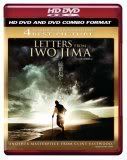
There are two ways to look at this film. One is to take this film as a standalone piece exploring the psyche of the Japanese side of Iwo Jima. The other view on this is to take this film in context and as a companion piece to director Clint Eastwood’s earlier and far inferior film about Iwo Jima, Flags of Our Fathers.
Taking this on its own merits, it is a great film. The story is focused, and we are given a fascinating look into the workings of the Japanese army. As the conditions on the ground begin to crumble as the American forces press on, the natural collapse of morale and discipline are shown in vivid detail. Eastwood does well managing this chaotic storyline of various characters meeting their imminent doom. Buttressed by screenwriter Iris Yamashita’s talent for character, Eastwood creates a stark portrait of men faced with internal and external existential wars to fight.
At the center of this film are two moving performances. The real lead in this piece is Kazunari Ninomiya. Ninomiya’s performance as Saigo, a poor baker who is torn from his love and conscripted into the army, carries the film. He is a critical figure in the film since he is the only character most people will be able to fully connect to. He is somewhat sarcastic and lacking the compliance or commitment to his army’s call. He is a common man yanked into the maelstrom of the Pacific theater. The other main focus of the piece is General Tadamichi Kuribayashi, portrayed by Ken Watanabe (The Last Samurai). Watanabe brings his natural charisma to the role and fills the shoes of a general quite well. He is a thoughtful leader who was educated in America. His leadership mismatches the brutal discipline of his underlings. This rift creates much of the film's early conflicts from which the characters are allowed to express themselves before the fighting begins. Kuribayashi is likewise a pawn and cast into the pit along with his men. The difference with his character is that he knows its coming. He goes into the fight with the Americans fully aware he cannot win.
Eastwood patently moves through subplots and minor characters to keep hammering home the uselessness of the venture of making war. From the upper echelon to the lowest grunt, we are shown that the wages of war are deep and, apparently in Eastwood’s eyes, not worth it. The full impact of the piece is muddled however given the inability for the characters to fully connect. In all of their effort to bring the expanse of the battle to the screen, Eastwood and Yamashita move around too much and too quickly. This battle went on for thirty-five days. Because of the hurried script it seems like the defeat of the Japanese came quick. The Americans land, there’s a couple of scuffles and the Japanese begin killing themselves. There is absolutely no feel to the timeframe involved. This breaks down the drama faced by these men, and saps some of the energy from the piece. When the final climatic moment occurs the lack of perspective comes to bear. While it is certain these men faced hard and violent times, the full scope of their endurance is missing.
Also missing from this piece is an honest look at who these guys were as soldiers and what they were capable of given their worldview. In this film it is the Americans who are shown to be brutish and cruel. While there is one individual Japanese officer who beats his men, the others are shown to be regular guys. While, yes, the Japanese soldiers we're all fully committed to the cause, it is important to remember that many were and that the Japanese army fully capable of horrible atrocities on the level of the Nazis. One has to look at Eastwood’s portrait and ask would this still be acceptable if he was showing us a sympathetic side to German forces? The Axis in WWII were strongly evil forces and Eastwood casually dismisses this in his work.
Overall, taken as a standalone piece this is successful and worth seeing at least once. Eastwood’s tendency to get long winded works in this piece as it is balanced out by Yamashita’s episodic writing. For those who love war film, this is a must see production. For those looking for an escape into comfortable entertainment, this may be a little too heady.
Cautions: Obviously, given that this is a frank look at war, this is a very violent film. Only a moron would go in thinking it would be otherwise.
So then, if you're a moron - be careful.
Related Reviews:
Clint Eastwood movies
Million Dollar Baby (2004)
Flags of Our Fathers (2006)
Other Critic's Reviews:
FilmCritic.com
Dear Cinema
Labels: Clint Eastwood, film, Kazunari Ninomiya, Ken Watanabe, movie review, war, World War II
posted by Michelle Obama's Left Nut at 9:00 AM
0 comment(s)
Share





















Good News Film Reviews LLC 2004-2010 - used with permission
Images, video and titles are the property of their respective copyright holders. Good News Film Reviews LLC claims no ownership or connection to them.
The views expressed on this site are not the opinion of any advertiser or external entity.
While we take care to only link to responsible entities, Good News Film Reviews LLC takes no responsibility for the content linked from this site. There are sharks in the waters. Surf at your own risk.
The Template is generated via PsycHo and is Licensed.