

No.
Remember this if you watch the movie. The soldier he presents he believes is a racist coward who killed innocents for nothing.
Congratulations vets - this is who is representing you now. Welcome home.
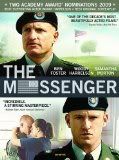

Films are not just a reflection of our society. They are a mode of communication that also provides direction on how the population should think about itself.
Regarding the War in Iraq, Hollywood has broken things down into two distinct camps.
1) Prior to The Surge, American Soldiers were ruthless, torturing barbarians unleashed by a corrupt and brutal Government (search for the film Redacted for the best example of this line of thinking).
2) Following The Surge in 2007, Hollywood couldn't portray soldiers as negatively since we were "winning" and the death toll was declining. Film makers quickly switched to presenting American vets returning from the battlefield. These veterans are all shown as despondent, confused, probable substance abusers and potential psychopaths. (such as In the Valley of Elah (2007) & The Torturer (2008)) No one escapes Iraq without PTSD.
While PTSD certainly exists and soldiers have come back with all manner of difficult problems to overcome, Hollywood seems compelled to only show the ugly side of their service. No films show heroic deeds. No films showing the men and women of valor doing their duty. Certainly no films showing the brutal nature of the enemy they were facing or the obscene and violent culture our service people were forced to confront.
Hollywood spent the first few years of the war undermining the troops. The war turns and things get better - do they go to spending their resources portraying soldiers as heroes who have served with honor? Nope. Since 2007 we have had a continual flow of messed-up, used-up, potential psychos/drunks suffering like rape victims with crew-cuts.
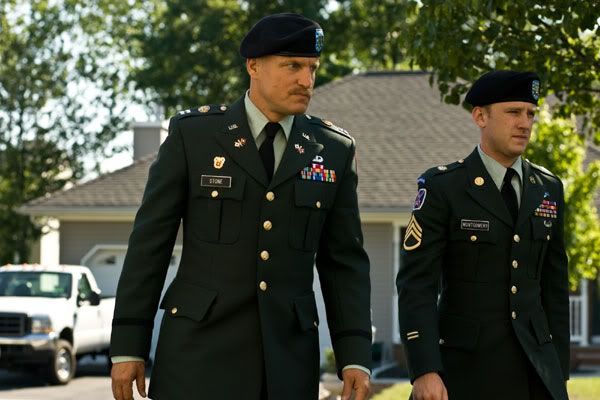
This film shows Staff Sergeant Will Montgomery (Ben Foster) who has just returned from IraqMontgomery suffers from the injuries he obtain from a IED and is simply waiting for his enlistment to run out. He is put to work on a Casualty Notification Team, even though he has no experience telling people their family member is dead. He is teamed with the more experienced Captain Tony Stone (Woody Harrelson). Stone is, of course, a former drunk.
Montgomery falls for one of the widows, Olivia Pitterson (Samantha Morton). The widow Pitterson. Pitterson. Pitterson = pity = sympathy. Heck, why not just name the character Olive Branch and call it a day?
In short, they're all screwed up. Everyone's moral compass is broken. It's all misery and despondency back home.
The film itself is not half bad. There's good performances by Foster and Harrelson and they make for an interesting pairing. The issue here is that the film is thick with self-importance. Every moment seems loaded with a "this is heavy stuff" vibe that simply kills the production. Instead of simply being dramatic, the film want you to know its being dramatic and overplays its hand.
The other issue is that this is just another in the line of films that is essentially a slap in the face of our returning vets. If film makers would have spent any time at all presenting the war outside of an Abu Ghraib-esque light, movies like these would be easier to swallow. Given the string of Iraq War movies and what they are saying about our troops? This seems to be just another lump of agitprop against the military.
Related Reviews:
Ben Foster movies
30 Days of Night (2007)
3:10 to Yuma (2007)
Other Critic's Reviews:
Christianity Today
Meet in the Lobby
Click here to buy your copy of

You Are What You See:
Watching Movies Through a Christian Lens
Labels: Ben Foster, film, Jena Malone, movie review, Samantha Morton, Steve Buscemi, Woody Harrelson
posted by Michelle Obama's Left Nut at 8:00 AM
0 comment(s)


Share
The film itself? As is the case with any film about the military over the past forty years, it all depends on how seriously they take it. It is hard to imagine a film maker being irresponsible or clumsily political while dealing with this kind of topic - but would you really be surprised if they were?
This does look good, but it does strike me that with only a few exceptions like The Hurt Locker, film makers can only bring themselves to discuss our soldiers only by focusing on them after they come home, dead or alive (In the Valley of Elah, Home of the Brave, Cost of a Soul, Taking Chance, Grace Is Gone, Stop-Loss, The Lucky Ones, Brothers). No investigation on what our men and women are seeing "over there". No mention of the absolute depraved condition of the Muslim world or the struggling people looking for freedom. No discussion of if what we've been doing all this time has been worth it or why we've been doing it. We just get a line of films showing our men and women in uniform racked with guilt, post-traumatic stress disorder, maimed or dead.
By avoiding the war and the moral questions involved in its execution, film makers can continue to undermine our troops. The entertainment industry was comfortable painting our soldiers as barbarians while the Iraq War was at its height. Now, we're seeing that the industry has changed from attacking our men by slander to attacking them with sympathy. What we have is film makers holding up returning soldiers (the same that were maligned for years) and saying to the world "look at what we've done to these poor souls." Instead of identifying them as returning heroes, it seems Hollywood is more satisfied to cite them as pitiable victims.
It is a good thing to talk about our men and women in uniform and discuss the issues they are faced with. It is important that we give them the context they deserve and be very careful about reducing them to mere props.
Screenwriters: Oren Moverman (I'm Not There) and Alessandro Camon (The Bandit K.)
Director: Oren Moverman
Actors: Ben Foster (Hostage), Jena Malone (The Ruins), Woody Harrelson (2012), Steve Buscemi (Armageddon), Eamonn Walker (Cadillac Records) and Samantha Morton (Minority Report)
Labels: Ben Foster, Eamonn Walker, film, Jena Malone, movie trailer, Samantha Morton, Steve Buscemi, Woody Harrelson
posted by Michelle Obama's Left Nut at 6:00 PM
0 comment(s)
Share


Short Review: Here's a shocker, a musician who's a depressive and selfish jerk. Wow, that's so unique, we better make a movie about him.
I've never been interested in Joy Division's music and never had much need to know anything about them. I come to this movie as a completely disinterested party. Actually, that's not true, as someone who has seen a lot of movies, I did come to this with the hope that this wasn't going to be yet another self-absorbed jackass who finds success and then destroys his life just like Walk the Line, Ray, The Doors, and Sid & Nancy. Although I liked these movies, they tend to be very predictable, overly sympathetic to the artist, and just plain depressing.
This movie sticks to the template but cuts out the sympathy. This is a predictable film for anyone with cursory knowledge of English pop culture, Curtis has been dead for 28 years now, we know how this is going to end. Where this film breaks from the crowd is in its warts-and-all look at the man. Where Walk the Line and Ray are splashy, epic feeling odes, this is a gritty examination of the artistic mind and the often dark results it produces.
The film follows the rise and abrupt fall of Joy Division's front man Ian Curtis. Curtis is a mopey fellow with a haunting voice. As his band climbs through the ranks for the Manchester music scene, he hastily marries his girlfriend Deborah. Like clockwork, as Ian's fortunes rise, his marriage falls apart. This collapse is plain to see given the two appear to be far too immature when they tie the knot. It is also plain to see that Curtis is too selfish to be in a serious relationship. They crank out out a child and the pressures of life begin to weigh the singer down. On top of this, he is stricken with epilepsy which intrudes on his band's live performances as well as his private life.
The implosion of Ian Curtis is reminiscent of Jim Morrison in many ways. Both were deeply selfish men who were spurred on by their associates and fans. Both preferred to look through the back end of life instead of trying to see anything actually beautiful in existence. Both cruelly tormented those who loved them. And both could have been spared their fate by getting some help.
Director Anton Corbijn (known for his work making videos for U2 and Depeche Mode) does well to connect Curtis to the pantheon of rock stars. He clearly lines Curtis up with the likes of Morrison, David Bowie and Lou Reed and the film is very successful at establishing Joy Division's worth. He also does a fantastic job at getting at the sorrowful man's private life and choices.
The film doesn't give Curtis any sympathy at all, in fact, he comes off as a horrible person, not for who he is but the ultimate choices he makes. Again and again, he is given a chance to be redeemed , to be something - to live for someone other than himself. In his depressive stupor, he chooses to feed his own needs and eventually finds himself completely isolated. Corbijn, in his feature debut, handles the subject with a gentle but unflinching hand and gives us a film that, while a little slow, is nonetheless enthralling.
The performances are as strong as the direction. Sam Riley is mesmerizing as Curtis. Much of Curtis' issues are internal and Riley gives light to these dark thoughts in a quietly intense performance that is worthy of a best-actor nomination.
Opposite Riley is Samantha Morton (Elizabeth: The Golden Age) as Curtis' estranged wife Deborah. Usually, in these stories of imploding artists, the girlfriend or first wife is a cursory character who is pushed aside once the narrative moves along (see Walk the Line for a great example of this, Vivian Liberto, is cast aside by the film like yesterday's trash). In this story however, the abandoned wife clings on and we see the devastation brought on by the artist's myopia. Morton is brilliant in this role and honors Deborah Curtis with fair and moving performance. This woman obviously had to deal with a huge amount of pain being married to this man.
This movie is depressing and not for everyone. I recommend it but only if you're into watching depressing, independent flicks about self absorbed jerks. Being a former self-absorbed jerk myself, (now I'm just a jerk,) I can enjoy aspects of this film. I'd be surprised if there is a large audience for this kind of film.
Cautions: Foul language abounds but it is all contextual. It is a part of the culture shown in the film and hardly gratuitous. Although there is a adulterous affair in the center of the story, it is handled with care. Corbijn is thoughtful director and doesn't play the more lurid parts of this story for cheap thrills.
Worldview: Curtis was clearly a troubled guy. The opening scenes show Curtis as a teen in his dingy bedroom with pictures of David Bowie and Lou Reed hanging on his wall. Racked with teenage angst, Curtis loses himself in listening to music and going to concerts. His trouble isn't unique or spectacular - he's just another Goth kid in the making. Your artsy types are a temperamental lot.
The teenage years come to a close with Curtis dressing himself in glam rock style, mascara and frills, gender bending in the safety of his own bedroom. From early on Curtis is at odds with himself. You don't begin emulating Ziggy Stardust because he's cool, one does it because they want to escape what they really are - normal.
As Curtis gets older and his band succeeds it's precisely the normality of life that seems to drag him down. He has a lovely wife, a beautiful daughter and makes a living honestly helping people by locating jobs for the disadvantaged. Everything the man needed to be a complete person, a happy person, was at his fingertips. But Curtis was blinded by is angst, unimpressed with normality, he reveled in his torment thinking it was valuable.
His torments seem to come right from the verses of Ecclesiastes 2:17
So I hated life, because the work that is done under the sun was grievous to me. All of it is meaningless, a chasing after the wind.
His troubled mind wasn't petty, but it was littered with the results of looking for peace in the wrong place. Worshiping rock stars and actors and looking to them for leadership is foolish. When you seriously consume messages of anger, depression and spite, impact the way you see the world.
Curtis replicated what he consumed and became another sour lyricist projecting his sorrow in his music. His music, as interesting as some of it may be, does nothing to improve the world. He, like many artists, believed the lie that he needed to coddle his depression and denounce the world in order to be authentic.
In the end, his disintegration was not surprising. When we deny the beauty of the world - a world created by God ,the meaningless of existence will overcome the best defenses and self-loathing and bitterness will be the result. The real shame of suicide is its angering senselessness. Curtis' death destroyed a number of lives beyond his own. All he needed to do to was turn his pathetic self around and see the real world around him.
Related Reviews:
Samantha Morton movies
Code 46 (2003)
The Libertine (2004)
Other Critic's Reviews:
Rolling Stone
The Times of London
Click here to buy your copy of
You Are What You See and learn
to change the world from your couch
Labels: Anton Corbijn, biography, film, Ian Curtis, movie review, music, Sam Riley, Samantha Morton
posted by Michelle Obama's Left Nut at 7:54 PM
2 comment(s)
Share





















Good News Film Reviews LLC 2004-2010 - used with permission
Images, video and titles are the property of their respective copyright holders. Good News Film Reviews LLC claims no ownership or connection to them.
The views expressed on this site are not the opinion of any advertiser or external entity.
While we take care to only link to responsible entities, Good News Film Reviews LLC takes no responsibility for the content linked from this site. There are sharks in the waters. Surf at your own risk.
The Template is generated via PsycHo and is Licensed.