

Short Review: One of the best westerns made.
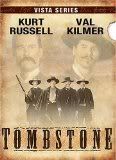

Kurt Russell, Val Kilmer, Sam Elliott, Bill Paxton, Michael Biehn, Powers Boothe, Charlton Heston, Stephen Lang, Thomas Haden Church, Dana Delany, Michael Rooker and Billy Bob Thornton - All of them and you toss in Robert Mitchum doing the narration for good measure? This is how you cast your Western.
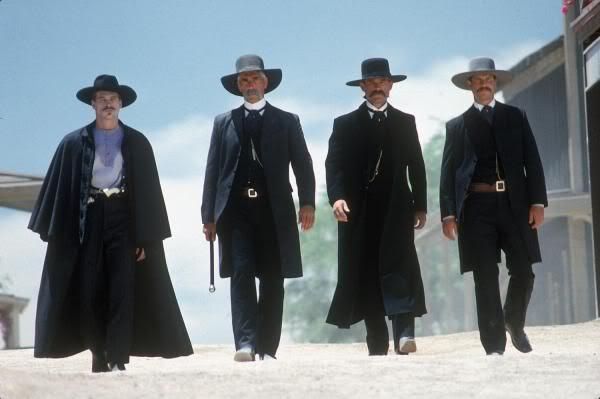
This is a film that others in Hollywood movies should emulate. Directors George P. Cosmatos and Kurt Russell explore the familiar tale of the shoot-out at the OK Corral . Following his famed stewardship of Dodge City, Wyatt Earp (Kurt Russell), retires to Tombstone, Arizona where he hopes to live a quiet existence with his brothers and their friend Doc Holiday (Val Kilmer).
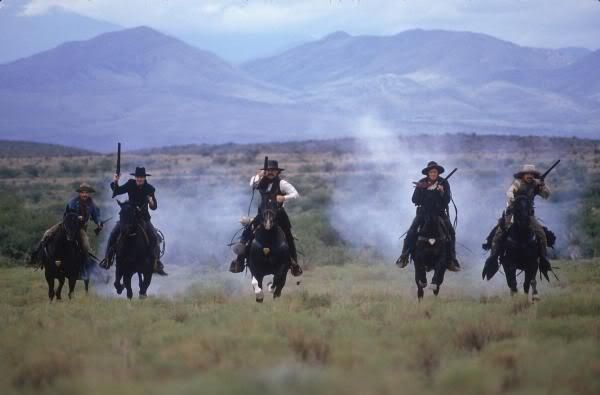
Earp's idyllic dreams are ruined by the Cowboys, a band of outlaws, who threaten the small town. The Earp Brothers, along with Holiday, face down the brutal outlaws. The conflict leads to the final shoot-out that made all of the men legends.
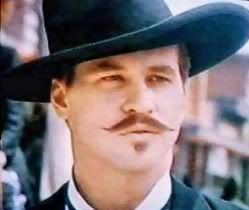 While the cast is impressive, it is Val Kilmer who makes the movie. His turn as Doc Holiday is one of the great performances in the genre and one of the best film performances of the 1990's. His sly, fatalistic Holiday is reason enough to see the film.
 Doc Holiday is presented as an ominous gunslinger who has the capacity to bring quick death to anyone. His ever present danger is undercut by terminal illness. He is racked with tuberculosis and is physically fading. The duality of a dying man who is forced to summon the skills of his healthier days is fascinating to watch.
Kevin Jarre’s script is perfectly paced and full of so many brilliant lines I can’t decide where to begin my praise. The dialog in this script puts most screenwriters to shame. Characters should always have heightened speech. The best way to elevate your characters is through the words that flow from their lips. Jarre offers his characters great lines that perfectly match their personalities. Not once does the elevated language feel imposed. Another example of this use of grand language is Pirates of The Caribbean series (written by Ted Elliot and Terry Rossio.)
Jarre’s wise use of language meshed with Kurt Russell’s confident performance give credence to the fear that Wyatt Earp puts into those around him even though he doesn’t use his gun until the midpoint of the film.
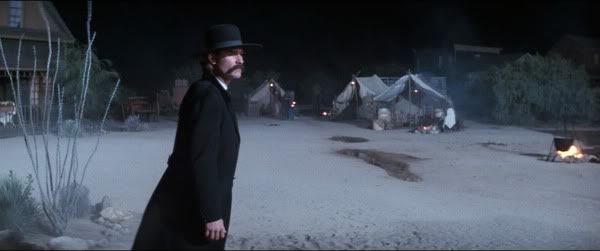
are you going to just stand there and bleed?”
"[slaps Tyler across the face, unafraid]
I'm gettin' tired of all your gas, now jerk that pistol and go to work!
[slaps him harder, now completely steely-eyed]
I said throw down, boy! "
"You die first, get it? Your friends might get me in a rush,
but not before I make your head into a canoe, you understand me?"
And then there is Doc Holiday.
Now I really hate him."
"Nonsense, I have not yet begun to defile myself."
Children, that is how you write dialog.
This is how you make a movie.
Cautions: Obviously, since this deals with the shoot-out at the OK Corral, there is violence. In comparison to what you see on TV these days, the violence is not out of hand.
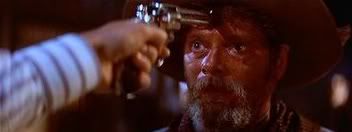
Worldview: Men are fallen and their hunger knows no bounds. This hunger for power, sex, wealth drive many to commit atrocities. These horrors can happen on large and small scales. The immediate threat the Cowboys pose to the peace of Tombstone is an interesting moral problem that replicates the one found in war zones. When is it acceptable for a man to pull the trigger? To kill another man?
The sixth commandment states "You shalt not murder". Murdering is different than killing. Murder assumes no moral right is promoted by the act. Murder is wasteful and hateful. One is permitted to kill as the need arises however. But where does that moment come?
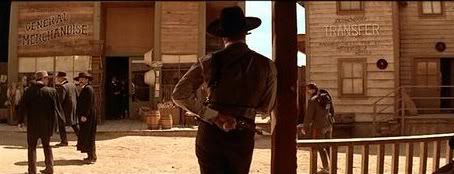
Self-defense is one of the central human rights. The ability to be free is centered on this concept. Wyatt Earp tries to shirk the concerns over the Cowboys, up to the point where violence is visited upon his family.
Wyatt refuses the role of Sheriff only to have his brother Morgan take up the position. Morgan is the calm soul, the thoughtful brother who says at one point "God made all this and He remembered to make a little speck like me." He is not the one to confront the evil of the world alone. That is Wyatt's calling. Wyatt's hesitation to stand up to evil costs both him and Morgan dearly.
Related Reviews:
Westerns
3:10 to Yuma (2007)
Shane (1953)
Other Critic's Reviews:
ReelViews
Celluloid Heroes
Click here to buy your copy of

You Are What You See and learn
to change the world from your couch
Labels: Bill Paxton, Billy Bob Thornton, Charlton Heston, film, Kurt Russell, Michael Biehn, movie review, Powers Boothe, Sam Elliott, Stephen Lang, Thomas Haden Church, Val Kilmer, western
posted by Michelle Obama's Left Nut at 8:00 AM
0 comment(s)


Share
Yes.

Ed Harris isn’t a brilliant director by any stretch of the imagination but he is a reliable one. Not surprisingly, his film (as was his previous work Pollack) is very strong on the performances. He knows how to draw good work out of his fellow cast members. This is an obvious benefit from his expertise in acting. He is also very smart in his casting choices. In this case he matched Viggo Mortensen (who I don’t think is capable of giving a poor performance), Renée Zellweger and Jeremy Irons with roles that play to their talents. The script by Robert Knott and Ed Harris (a first writing credit for both actors) is based on the novel by Robert B. Parker. It is clear the two men were cautious to give the story room to develop and their actors plenty of material to handle. While the performances are fantastic, the script is the foundation for the successes in the production.
The story centers around a couple of guns for hire who are brought in to police a small Western town. The men Virgil Cole (Harris) and Everett (Mortensen) are opposites that complement one another. Virgil is a stony eyed, simple minded law man. Everett is a laid back, literate man. The partners are confronted by two serious issues in their new town. First is Randall Bragg (Irons), a murderous rancher. The other is piano player Allison (Zellweger) who starts a rocky relationship with Virgil. The conflicts and tension between the characters is patiently built mostly through character development instead of cheap plot devices. While there are some dry moments, the film overall avoids falling into being a chat fest. Harris walks a delicate tightrope between being too heavy on the dialog and just being another gunfight Western. The fact that he avoids these traps is made even more impressive when one realizes that the film also avoids almost all Western cliche in the process. Even if you don’t like the film, you have to give credit that this was not lazily made. If nothing else, Harris is a very deliberate film maker and obviously works hard to get his results.

Related Reviews:
Ed Harris movies
Glengarry Glen Ross (1992)
Gone Baby Gone (2007)
Other Critic’s Reviews:
Ill-Informed Gadfly
Christianity Today
Labels: Ed Harris, film, Jeremy Irons, movie review, Renee Zellweger, Viggo Mortensen, western
posted by Michelle Obama's Left Nut at 8:00 AM
0 comment(s)
Share
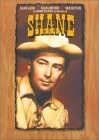

Director George Stevens makes this a strange film in many respects. The way the tale is told is simplistic but carries a deeper message of sacrifice. Shane is clearly a Christ figure, one of the most striking ones put to film. His dealing with evil on behalf of the settlers has an epic feel to it despite of it's small scale. The hero himself is atypical. Roger Ebert points out that he looks a "tad precious" and he is right. Alan Ladd is a leading man, but one made for romatic leads, not brawling. His casting is an inspired choice. Ladd's slight frame combined with his character's casual bravery shows the character's inner strength, a will that the snarling villains do not retain. Another element that is striking about this film is how it's filmed. The rich colors and picturesque sets looks like a dream, a memory of the child Joey, son of the farmers who idolizes the gunfighter. The dreamy vibe of the film gives it a unique flavor that makes it stand out against all other Westerns.
This is a simple film but it is also a great one. The surprising lack of gunplay considering the whole movie openly promises to lead up to a violent conclusion. Stevens wisely avoids making a spectacle of the violence and treats it with a respectful tone not normally seen in Westerns. He also relies heavy on the tension between characters to drive his story. While his story is very simple, his execution is layered and complicated. He shows brilliantly that clever plot twists don't make a great film, strong storytelling does.
Related Reviews:
Westerns
The Tin Star (1957)
The Shootist (1976)
Other Critic's Reviews:
Decent Films Guide
Roger Ebert
Labels: Alan Ladd, film, Jack Palance, Jean Arthur, movie review, Van Heflin, western
posted by Michelle Obama's Left Nut at 5:00 PM
0 comment(s)
Share
No.
Short Review: Not worth a dime.


Every time I see Charleston Heston in a movie, no matter if he’s a cowboy or gladiator, I keep waiting for him to bellow “Get your hands off me you damn dirty ape!” In some cases, the films would have vastly improved if he had done this.
Heston, before becoming a human political lightning rod, was one of the great Hollywood actors. I’ve never been a huge fan of his broad acting style. Usually, I find his performances to be forced and at times embarrassing. That said, the man commanded attention and whoa was he gifted with some pipes. The guy could read the instructional manual to my digital camera and make it sound like it was written by God himself.
Heston’s voice and larger than life presence couldn’t be put to less use in this film. Confused and insulting, this movie wastes more time than Al Franken’s make-up artist.
This story manages quite a feat. It’s as if writer/director Tom Gries sat down with two or three scripts, removed all of the cool scenes, and taped the rest together to make this mess. Gries attempts to break the western mold, not that this is really a western in the normal sense. He tries to deliver a realistic portrayal while steering away from traditional motifs. The film meanders a bit at the beginning and succeeds at being quite interesting. We are presented with a real man struggling with the very hard life of a cowboy. Heston plays the titular character, a tired, old cowboy who takes on the job of watching over a large ranch. He finds a mother and son squatting on the property. He lets them stay on the land. Before too long a crazed preacher and his minions, who Penny previously had a fight with, shows up for revenge. Prior to the preacher business, there's a realness to the beginning of the film that shows great promise. The striking beginning is then washed away by the stupidity of the rest of the film. When the main antagonist, Preacher Quint, is introduced the whole piece moves from being thoughtful and realistic to being retarded and then more retarded.
The unashamed anti-Christian portrayal by master over-actor Donald Pleasance as the wild-eyed psycho Quint is notable. Pleasance offers a number of almost unwatchable scenes involving his quivering denunciations of his enemies with fevered mini-sermons. The Christian as crazed loon is not uncommon to see in film, although its appearance seems to be on the decline, thankfully. The point is to combine the control and power of God and the frail emotionality of mankind…or something like that. Really what it is, is an attempt to be scary. A guy with a gun is scary. A guy with a gun saying something from The Bible is scarier still. Today, of course, a guy with a gun saying something from The Koran is just misunderstood and if you're scared you're probably a racist...but that’s a different subject isn’t it?
Christians will not have to be terribly patient to be offended and film lovers won’t be far behind. This is just a plain ol’ bad movie that offends because those who made it weren’t clever enough not to be so. The morality expressed in the movie exposes an immaturity that explains the rest of the piece. Don't waste your time.
Related Reviews:
Charlton Heston movies
Omega Man (1971)
Tombstone (1993)
Other Critic's Reviews:
Roger Ebert
Reel.com
Labels: Charlton Heston, Donald Pleasance, film, movie review, western
posted by Michelle Obama's Left Nut at 9:00 AM
1 comment(s)
Share
Nope.

Related Reviews:
John Wayne movies
Sands of Iwo Jima (1949)
The Man Who Shot Liberty Valance (1962)
Other Critic's Reviews:
eFilmCritic
EOpinions.com
Labels: film, John Wayne, movie review, western
posted by Michelle Obama's Left Nut at 5:00 PM
0 comment(s)
Share
Yes.
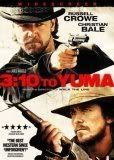

As a general rule I am against remakes. The recent trend is to rehash every recognizable title in cinematic history into a cheap facsimile, fabricated for a culture that no longer cares. To be honest, when I first heard they were remaking this classic, I expected a disappointing and unneeded film until I saw Christian Bale and Russell Crowe fronted the production.
Fortunately, this is a well-conceived film that is definitely worth your attention. Both Bale and Crowe give substantive performances. Crowe plays Ben Wade, an infamous criminal who has been condemned to be hanged at Yuma Prison for his sins. Crowe is well at ease in this role of a seductive, smiling criminal who can be murderous one moment and glad handing the next. Bale is Dan Evans, a financially strapped rancher, who also happens to be a great shot. When no one else is up to the task, Dan volunteers to deliver Ben to his judgment.
As Dan and his compatriots deliver Ben to the 3:10 train to Yuma, they run into all matter of danger and are pursued by Ben's gang. The gang is headed by the wild-eyed Charlie Prince (Ben Foster) who is flushed with rage and has a tendency to accommodate his itchy trigger finger. Foster overacts his part but his broad performance still works. His character is meant to soften Ben's villainy. Ben may be a bad man, but he's not as bad as that sharp toothed snake of man Prince.
Throughout the film Ben offers Dan numerous chances to avoid is duty, to break his word. It is clear that Dan will not survive the trip, Ben's gang will find him and they will kill him. It is likewise clear that Ben will not bend. He is the only man of honor in the film. He stands by justice and he does not yield.
The film is expertly executed and founded in a very strong script updated by Derek Haas and Michael Brandt (Wanted). Along with the strong performances and steady direction, this film is a blueprint on how to remake a movie.
Cautions: This is a violent film. The violence isn't gratuitous but it is plentiful. Those with sensitivity to violence should reconsider seeing the movie.
Related Reviews:
Christian Bale movies
Batman Begins (2005)
The Prestige (2006)
Other Critic's Reviews:
Cinema Dave
Ill-Informed Gadfly
Click here to buy your copy of
You Are What You See and learn
to change the world from your couch
Labels: Christian Bale, film, movie review, remake, Russell Crowe, western
posted by Michelle Obama's Left Nut at 6:00 PM
3 comment(s)
Share
Yes.
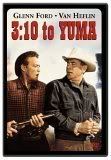

Glenn Ford (Gilda) offers a charismatic and memorable performance. Van Heflin (Shane) is perfectly cast as the capable rancher who has stepped into a situation top big for him to control. While the script is missing the detailed characterization of the 2007 remake the film still delivers good drama. Helfin and Ford are well matched, Ford's relaxed smirk against Heflin's weary mug. The two play off one another and enhance the other's performance.
This is a good film if you’re a patient audience. If you’re looking for wall to wall action you’ll do better elsewhere. This is a good back up pick if you need one.
Related Reviews:
Another Glenn Ford movie
Gilda (1946)
Other Critic's Reviews:
eFilmCritic
ReelTalk
Click here to buy your copy of
You Are What You See and learn
to change the world from your couch
Labels: film, Glenn Ford, movie review, Van Heflin, western
posted by Michelle Obama's Left Nut at 1:16 PM
0 comment(s)
Share





















Good News Film Reviews LLC 2004-2010 - used with permission
Images, video and titles are the property of their respective copyright holders. Good News Film Reviews LLC claims no ownership or connection to them.
The views expressed on this site are not the opinion of any advertiser or external entity.
While we take care to only link to responsible entities, Good News Film Reviews LLC takes no responsibility for the content linked from this site. There are sharks in the waters. Surf at your own risk.
The Template is generated via PsycHo and is Licensed.