


The Lawnmower Man takes what could have been an interesting premise about virtual reality and turns it into a hulking, clunking movie better suited for the Syfy channel than for cinemas. If it were made today, I have little doubt that it would have been a Syfy channel original movie starring Bruce Campbell. Instead, we get a movie with Pierce Brosnan. At least Bruce Campbell would have been funnier.
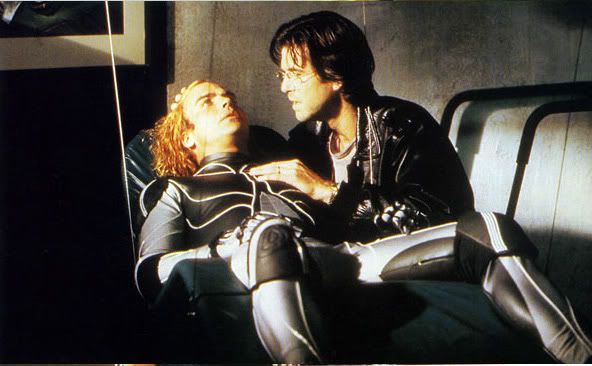 The movie stars Jeff Fahey as a mentally handicapped lawnmower man who is made the subject of human testing designed to further test virtual reality and, in the process, make him smarter. This is instigated by a scientist played by Brosnan. This was clearly the role that the producers of the James Bond films watched and then said to themselves “that’s our 007,” for who better to play the debonair super agent than a grizzled, boozy scientist with marriage woes, an earring, and a mullet. Goldeneye indeed! The rest of the movie is essentially a sci-fi remake of Flowers for Algernon, except in this rendition, the lead character takes names and kicks butt as he grows in intelligence.
All in all, it’s not the worst movie I’ve ever seen, but it doesn’t resemble a great viewing experience either. The special effects look like they were done by the director’s acid-tripping brother-in-law, some of the virtual reality sex scenes are enough to put off even the most perverted, and the world really doesn’t need to see James Bond nailed to the cross, which actually happens in this movie. Stephen King, whose story of the same name was the very loose inspiration for the movie, sued to have his name removed from the film. If the man who made Creepshow doesn’t want anything to do with your movie, isn’t that saying something?
About the author: James Mowery is a computer geek that writes about technology and related topics. To read more blog posts by him, go to led tv.
Click here to buy your copy of

You Are What You See:
Watching Movies Through a Christian Lens
Labels: film, guest movie review, Jeff Fahey, Pierce Brosnan, Stephen King
posted by Michelle Obama's Left Nut at 12:00 PM
0 comment(s)


Share
Brian De Palma's adaptation of Stephen King's horror classic gave society the iconic scene of Carrie White (Sissy Spacek) becoming the victim of the cruel prank of having pig blood is dumped on her at the High School Prom. The meek, abused girl then retaliates by decimating her classmates with her telekinetic powers.
What is often forgotten about this movie is the overwhelming anti-Christian bigotry that permeates the production. Carrie White is the victim not only of arrogant classmates but also of her psychotic, fanatic mother (Piper Laurie).
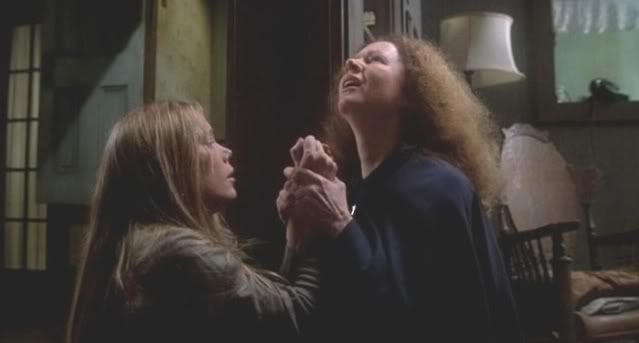 Carrie's mother is an insulting caricature I call the American Zealot, a character that has developed over the past forty years. The American Zealot is generally a southern Baptist type who is all fire and brimstone and no Heaven. They are the wild-eyed, intolerant and often violent Christian bogeymen that secularists warn are living under our cultural beds. You don't have to take a theology seriously if you can hype it up to ridiculous levels and then point to it and say "see, they're all dangerous crazies."
The film itself hasn't aged well at all. There has been a change in film making since the 1970's and those changes are very obvious in this case. The very intentional plotting, the twenty-odd-year-old actors pretending to be teenagers, the music. It all has a warped after-school special vibe that undermines any potential horror the film would otherwise offer.
Related Reviews:
Stephen King Movies
The Mist (2007)
The Shining (1980)
Other Critic's Reviews:
DVD Authority
11th Hour Reviews
Click here to buy your copy of
You Are What You See and learn
to change the world from your couch
Labels: film, John Travolta, movie review, Sissy Spacek, Stephen King
posted by Michelle Obama's Left Nut at 5:00 PM
0 comment(s)
Share
No.
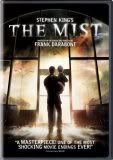

A strange mist overtakes a small northwestern town, trapping its citizens in the local supermarket. They barricade themselves in the store after they learn the mist houses horrible creatures looking to feast on them. Internal fighting and bad judgment erupt and people get picked off one by one as the audience is expected to sift through the usual Stephen King narrative of a supernatural force being confronted by a fumbling hero who finds himself surrounded by dim-eyed hicks and violent religious fanatics. All that is missing is a small child with supernatural powers.
The movie starts out strong. Thomas Jane (The Punisher) appears well cast as average guy David Drayton who spends his time painting movie posters in his large home that he shares with his happy son and loving wife. Jane is very approachable in his role and handles these establishing scenes quite well. Opposite him, Andre Braugher (Poseidon) likewise gives a solid opening performance. These work are completely undone once the characters decide to head into town and are trapped by the fog. Director Frank Darabont (The Green Mile) wants to transform this conventional monster movie into a study of human nature in a response to an apocalyptic circumstance. What he ends up with is a conventional monster movie with a lumpy subtext pushing people into illogical decisions and the narrative into unsatisfying tangents. The film resolves itself with an unbelievable coincidence that is insulting. It is clear Darabont wanted to bring this film to a meaningful close but his lack of focus leaves him stranded in end. He is forced to present one of the more embarrassing endings I've seen in a long time. The resolution is meaningless, and wholly illogical when placed against the rest of the film.
The ending is arguably the most important part of a film. If a movie doesn't offer a solid resolution then what's the point of watching it? Its like going on a drive only to end the trip parked in front of a garbage dump. It doesn't matter how scenic the journey is if you're just going to end up staring at refuse.
Cautions: There is plenty of violence and cursing. The gore in the film is completely gratuitous. We know getting eaten alive is painful, we don't need to see it happen. Well placed sprayed blood would have done the trick.
Worldview: There are some interesting symbolisms in the film which support some theological thinking but none of it is fully cooked. In the opening David, the hero, is literally making idols. He paints movies posters and is busy creating a painting of a movie idol. This work is destroyed when a storm comes and knocks a tree his grandfather planted through his window. David's calm Eden is interrupted by the growing evil outside his door. This is an interesting beginning and shows some thought has gone into the proceedings.
But Frank Darabont can't reconcile the existential knot he ties his film into. Characters continuously ask if God is punishing them while at the same time others demand God doesn't exist. The lone Christian at the opening of the film is Mrs. Carmody (calamity?) portrayed by one of my favorite actresses Marcia Gay Harden (although she overacts here.) Mrs. Carmody, who is of course crazy because, you know, all Christians are crazy, again and again cites passages from the Bible that seem to be proved by the events happening all around them. As she continues to be proven right she gains followers. Her beliefs then turns into religion (meaning her faith takes form and organizes) and as with all religion in film, it leads to evil. Her rising power among the citizens in the store eventually transforms her into a fevered religious monster who begins demanding human sacrifices. This witch hunt is predicated by the hero, who maligns her intentions and beliefs from the very beginning. So Darabont sees religion as being an evil player in human existence, one which is stated to be man made by a secondary character (no different than politics).
In the end, David and a band of secularists leave the safety of the grocery store, get into his car and brave the dangers of the mist. They drive until they run out of gas in the middle of nowhere. Now, the ending of the film is horrible to watch, but it is somewhat interesting. In the end, after all of this talk about the punishment of God and the end times, Darabont is forced to end his piece and deliver the movie's message. Darabont decides he wants it both ways. He's committed to an existential universe, but he can't let go of his belief in God. The answer? There's a god but he's the god of nihilism. In the end, David shoots his young son and his friends in a mercy killing. He then gets out of the car and waits to be killed by the monsters in the mist. Instead of finding death, the mist rises and the military shows up. The evil is receding. In essence, David is forced by God to sacrifice his son like Abraham, but in this instance, David is dealing with an existential god who doesn't interrupt the proceedings. Only when David is reduced to accept the hopelessness of existence is he allowed to carry on. On this point I could be completely off target however since Darabont's creation is a muddled one and the message is as foggy as his backdrops.
Related Reviews:
Stephen King movies
The Shining (1980)
Dreamcatcher (2003)
Other Critic's Reviews:
Creative Loafing
Roger Ebert
Labels: Andre Braugher, film, Marcia Gay Harden, movie review, Stephen King, Thomas Jane
posted by Michelle Obama's Left Nut at 9:00 AM
0 comment(s)
Share





















Good News Film Reviews LLC 2004-2010 - used with permission
Images, video and titles are the property of their respective copyright holders. Good News Film Reviews LLC claims no ownership or connection to them.
The views expressed on this site are not the opinion of any advertiser or external entity.
While we take care to only link to responsible entities, Good News Film Reviews LLC takes no responsibility for the content linked from this site. There are sharks in the waters. Surf at your own risk.
The Template is generated via PsycHo and is Licensed.